-
Shop
- Adidas
- Advanced Technologies
- AI Skills for Creators & Freelancers
- AI Client Management
- AI Ethics
- AI Mindset
- AI Tools & Prompts
- AI Writing & Content Creation
- Audio, Voice & Music
- Design & Visual Creation
- Email, Messaging & Communication
- Freelancing & Business
- Marketing, Ads & Conversion
- Productivity, Workflow & Automation
- SEO & Search Optimization
- Social Media Content & Growth
- Strategy, Planning & Analytics
- Video Creation & Editing
- Beauty
- Best-Sellers
- Car Accessories
- Car Buying & Ownership
- Confidence
- Dating & Social Skills
- Digital Resources
- Education & Learning
- Family & Parenting
- Fashion
- Accessories
- Alexander McQueen
- Bags
- Bags & Wallets
- Balenciaga
- Belts
- Blazers
- Bottega Veneta
- Brunello Cucinelli
- Burberry
- Chanel
- Chloé
- Dior
- Dolce & Gabbana
- Dresses
- Etro
- Fendi
- Gucci
- Hats & Hair Accessories
- Hoodies & Sweatshirts
- Jewelry
- Jil Sander
- Keychains
- Kiton
- Luggage
- Miu Miu
- Off-White
- Outerwear
- Prada
- Rick Owens
- Saint Laurent
- Shoes
- Socks & Tights
- Sweaters & Cardigans
- The Row
- Tom Ford
- Tops & Shirts
- Valentino
- Valentino Garavani
- Versace
- Vivienne Westwood
- Watches
- Fashion Accessories
- Furniture
- Gadgets
- Health & Beauty
- Health & Wellness
- Home & Garden
- Home Styling & Organization
- Home Supplies
- Kids & Babies
- Kitchen Best-Sellers
- Parenting & Child Development
- Patio, Lawn & Garden
- Personal Growth
- Personal Style & Fashion
- Pet Care
- Pet Lifestyle & Wellness
- Pet Supplies
- Pets
- Smart Home Living Guides
- Sport & Outdoors
- Stress Relief & Relaxation
- Super Deals
- Travel
- Travel & Adventure
- Wealth
- Wellness
4-Week Minimal-Equipment Home Workout Plan (Daily)
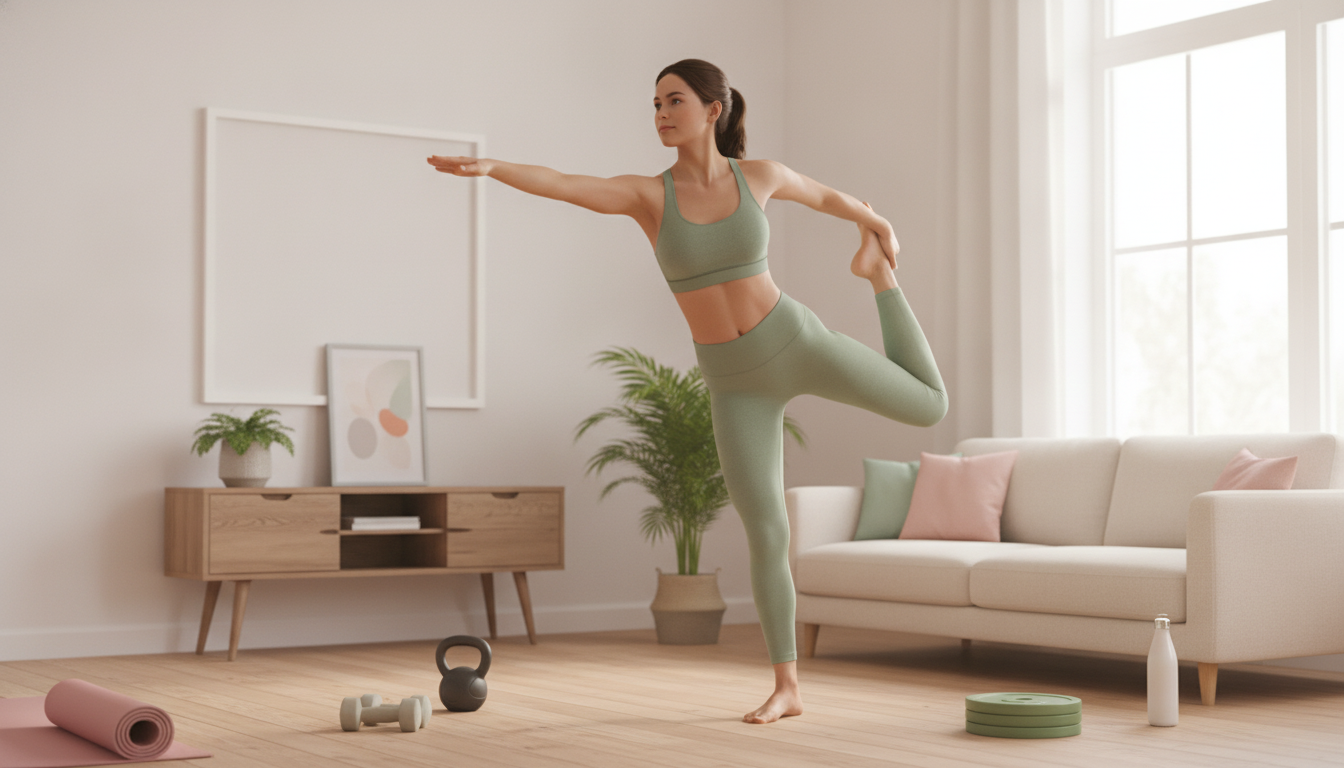
Fit at Home: A 4-Week Minimal-Equipment Workout Plan with Daily Workouts and Stretches
A structured four-week routine can make home training feel straightforward: clear daily sessions, simple progressions, and short mobility work that supports recovery. This plan focuses on full-body strength, conditioning, and flexibility using minimal equipment and small spaces, with built-in options to scale workouts up or down. For general activity targets and safe weekly volume, you can also reference the CDC’s physical activity basics and the American College of Sports Medicine recommendations.
What the 4-week plan includes
Each day follows the same easy-to-remember format: warm-up, main session, an optional finisher, and a short stretch sequence. The week is balanced so you’re not smashing the same muscles every day—there are dedicated days for lower body, upper body, core/mobility, conditioning, and recovery.
- Daily schedule format: warm-up, main session, finisher (optional), and a short stretch sequence
- Balanced weekly split: lower body, upper body, core, conditioning, and recovery-focused days
- Progression across weeks: gradual increases in volume, density (less rest), or movement difficulty
- Minimal equipment approach: bodyweight-first with optional add-ons (light dumbbells, resistance band, a chair/bench)
- Time-friendly sessions: commonly 20–45 minutes depending on level and add-ons
- Built-in modifications for beginners and intensity options for experienced trainees
Sample weekly rhythm (repeat with progressions for 4 weeks)
| Day | Focus | Main work (examples) | Stretch emphasis |
|---|---|---|---|
| Day 1 | Full-body strength | Squat pattern + push + row/pull alternative + core | Hips, chest |
| Day 2 | Conditioning | Low-impact intervals or brisk cardio + core | Calves, hamstrings |
| Day 3 | Lower body + glutes | Lunges/hinge + glute bridge variations | Hip flexors, glutes |
| Day 4 | Upper body | Push-ups/press + shoulder stability + back work | Shoulders, upper back |
| Day 5 | Core + mobility | Anti-rotation, carries (if available), mobility flow | Spine, thoracic rotation |
| Day 6 | Full-body circuit | Timed circuit (strength + cardio mix) | Full-body reset |
| Day 7 | Recovery | Walk, gentle mobility, light stretching | Relaxation + breathing |
Set up for success with minimal equipment
You don’t need a dedicated gym room—just a small, consistent setup that makes it easy to start. Clear a roughly 6×6 ft area and keep one sturdy chair or couch edge available for step-ups, supported split squats, or incline push-ups.
- Space checklist: clear a 6×6 ft area, plus a sturdy chair/couch edge for step-ups or incline push-ups
- Optional gear that expands exercise variety: resistance loop/band, light dumbbells/kettlebell, yoga mat
- Comfort and safety: supportive shoes for circuits (optional), towel, water bottle, timer/phone
- RPE intensity guide: aim for moderate effort on most sets (leave 2–3 reps in reserve), harder effort on select conditioning intervals
- Warm-up baseline (5–8 minutes): joint circles, hip hinges, bodyweight squats, scapular push-ups, easy cardio
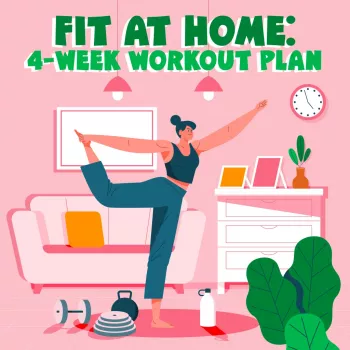
If you prefer a ready-to-follow checklist format, the Fit at Home: 4-Week Workout Plan (PDF) keeps the daily flow consistent so you spend less time planning and more time moving.
How progression works over 4 weeks
The goal is to progress without turning every session into a grind. Most improvements come from small, repeatable upgrades: a couple reps, one extra set, slightly shorter rests, or a harder variation.
- Week 1: learn movement patterns, pick sustainable reps and rest times, prioritize technique
- Week 2: add a set to key moves or add 2–3 reps per set while maintaining form
- Week 3: increase density (shorter rests) or upgrade variations (incline push-up → floor push-up; squat → tempo squat)
- Week 4: consolidate gains with a structured challenge week (controlled intensity, not all-out daily)
- Deload option: if recovery feels compromised, keep exercises the same and reduce total sets by ~20–30%
Daily workout structure (what each session should look like)
Keeping a consistent structure makes it easier to stay on track and measure progress. Think of the workout as four simple blocks:
Stretches and mobility for recovery (daily, minimal time)
Post-workout stretching should feel calming, not like a battle. Use gentle holds (20–40 seconds), avoid sharp pain, and pair each exhale with a little more relaxation. If you want a simple library of flexibility ideas, the NHS stretching guide is a solid reference.
Modifications for beginners and intensity options for experienced trainees
Downloadable guide option for a ready-to-follow schedule
A PDF-style program can remove decision fatigue by spelling out exercise order, daily checkboxes, and the stretch sequence you’ll do right after training. If you like having everything in one place, use Fit at Home: 4-Week Workout Plan (PDF) as your day-by-day roadmap.
For a simple way to keep workout essentials together (band, towel, notebook, water bottle), a roomy carry-all like the Amazing Song Pudding Bag can make it easier to keep your setup consistent—especially if you train in different rooms or travel.
Quick product snapshot
| Format | Duration | Equipment | Includes |
|---|---|---|---|
| Digital eBook / PDF | 4 weeks | Minimal equipment (bodyweight-friendly) | Daily workouts + stretches |
FAQ
How long should each home workout take?
Most sessions land in the 20–45 minute range depending on rest times and whether you add a finisher. If you’re short on time, do the warm-up plus the main block and save stretching for a quick 3–5 minutes.
Is minimal-equipment training enough to build strength?
Yes—progress comes from adding reps, slowing tempo, using unilateral variations, and reducing rest to increase training density. Bands or light dumbbells can expand options, but consistent form-focused effort is the main driver.
How many rest days are needed in a 4-week plan?
Plan for at least one lighter recovery day each week, and adjust based on soreness, sleep quality, and stress. If recovery feels off, keep the same exercises and cut total sets by about 20–30% for a short deload.
Recommended for you

Was this article helpful?
Yes
No








Leave a comment